Metadata
aliases: []
shorthands: {}
created: 2022-01-06 08:22:04
modified: 2022-01-10 04:13:04
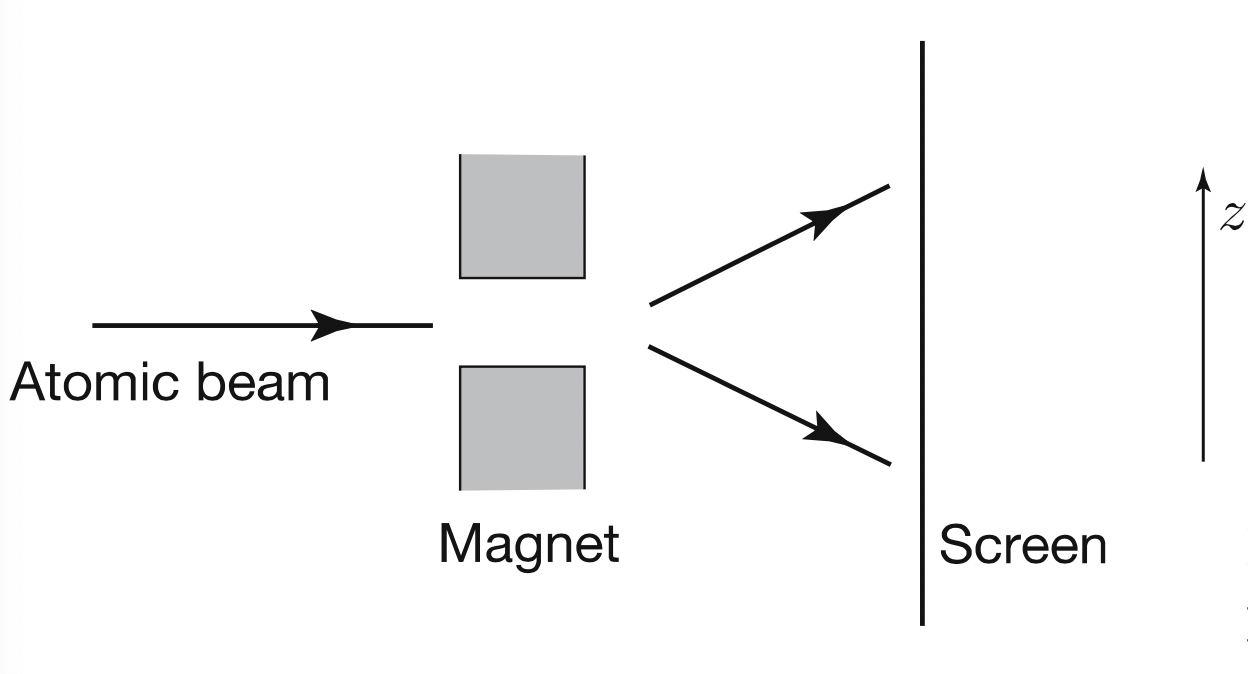
The Stern-Gerlach experiment is one of the experimental evidences that lead to the discovery of the spin for describing electrons in QM.
In the experiment, an atomic beam traverses an inhomogeneous magnetic field. In the normal Zeeman effect, we saw that the interaction term of the Hamiltonian operator is:
Where
Based on this, since the Hamiltonian gives the energy, the force acting on the atom is:
Here we assumed that the magnetic field is approximately parallel to the
From the preceding, one would expect a splitting into an odd number of beams